
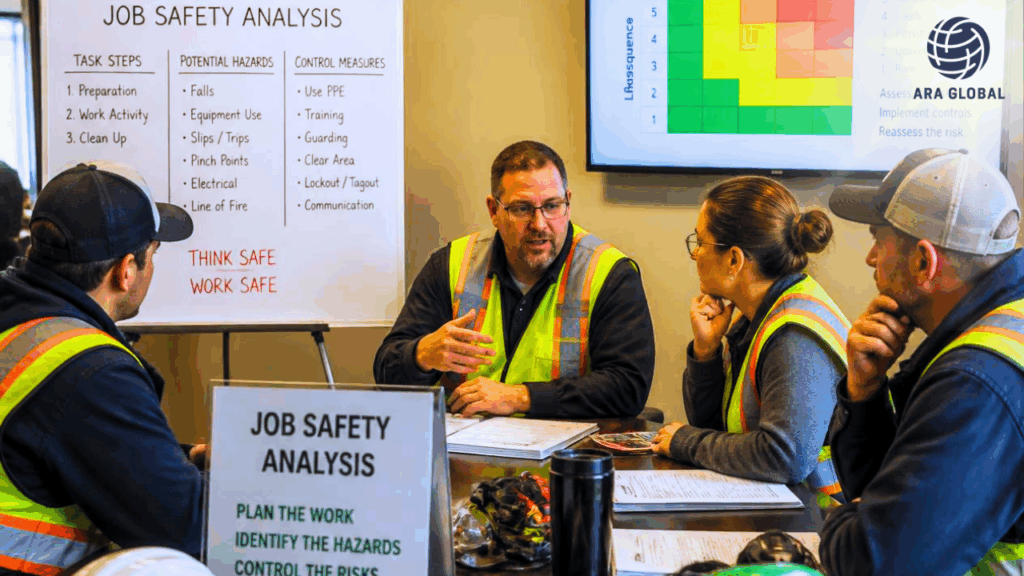
A job safety analysis helps teams understand what can go wrong before they start a task. Instead of waiting for an accident to reveal a problem, workers can identify hazards, assess risks, and decide how to control them in advance.
This approach becomes especially important when employees handle machinery, electrical systems, chemicals, work at height, or other high-risk activities. Therefore, a good JSA can make everyday work safer without making the process unnecessarily complicated.
The real value of a JSA comes from how teams use it. A form filled out only for compliance will not prevent an accident. However, a JSA that employees actually discuss and follow can become a practical safety tool.
What Is Job Safety Analysis?
Job safety analysis is a structured process that breaks a job into individual steps and examines the hazards associated with each step. The team then decides what controls can reduce those hazards before work begins.
For example, consider a maintenance task involving a machine. The team may identify electrical energy, moving parts, stored pressure, and unexpected machine movement as potential hazards.
The JSA then helps workers determine how to isolate the machine, control the energy, use the right PPE, and complete the task safely.
When Should You Conduct a JSA?
You do not need to wait for an accident to conduct a job safety analysis.
Consider a JSA when:
- Employees perform a new task.
- A process or machine changes.
- Workers perform high-risk activities.
- An incident or near miss occurs.
- A task involves several hazards.
- Employees use unfamiliar equipment.
- Existing controls no longer seem effective.
Moreover, reviewing a JSA after a workplace change helps ensure that your safety controls still match the actual working conditions.
Step 1: Select the Job
Start by choosing the task you want to analyse. Prioritize jobs that involve serious hazards, frequent incidents, complex procedures, or significant changes.
You should also involve employees who actually perform the job. Their practical experience can reveal risks that may not appear in a written procedure.
Step 2: Break the Job Into Steps
Next, divide the task into logical steps. Do not make the list too detailed. At the same time, avoid combining several important activities into one broad step.
For example, instead of writing “repair the machine,” break the activity into steps such as:
- Shut down the machine.
- Isolate the energy source.
- Verify zero energy.
- Remove the required component.
- Complete the repair.
- Restore the machine safely.
This makes the JSA procedure easier for workers to understand and follow.
Step 3: Identify the Hazards
Now ask what could cause harm at each stage.
Look beyond obvious hazards. Consider electrical energy, moving machinery, chemicals, heat, pressure, falls, manual handling, poor ergonomics, and unexpected changes in working conditions.
This stage forms the core of the job hazard analysis process.
A useful question is simple: “What could go wrong during this step?”
That question often leads the team to risks they might otherwise overlook.
Step 4: Decide on Controls
Once the team identifies hazards, determine how to control them.
Start with stronger controls rather than relying only on PPE.
For example, you may eliminate a hazardous step, isolate equipment, install guarding, improve ventilation, or introduce a safer work method.
Then consider administrative controls and PPE where appropriate. A practical JSA procedure should clearly explain these controls so workers know exactly what they need to do.
Step 5: Communicate Before Work
A JSA should reach the people who perform the task. Before starting the job, discuss the hazards and controls with the employees involved. Give workers an opportunity to ask questions and raise concerns.
Additionally, explain any changes from previous work. This conversation can turn a written job safety analysis into a useful safety discussion rather than another document sitting in a file.
Step 6: Review After the Job
The process should not end when the work finishes. Ask employees what worked well and whether they encountered any unexpected hazards. If conditions changed during the task, update the JSA accordingly.
This continuous review strengthens the JSA procedure and keeps the document useful for future work.
Common JSA Mistakes
Companies can weaken their JSA process without realizing it.
Common problems include:
- Copying old JSAs without reviewing the actual job
- Listing hazards without identifying controls
- Creating the JSA without employee input
- Using technical language workers do not understand
- Failing to update the JSA after process changes
- Treating the document as a compliance form
A strong job hazard analysis should reflect what employees actually experience at the workplace.
A Simple JSA Review
Before work begins, ask:
- What are we doing? – Clearly define the task.
- What can go wrong? – Identify hazards at every important step.
- How can we prevent it? – Select practical controls.
- Does everyone understand the controls? – Discuss the JSA with the people performing the work.
- Have conditions changed? – Review the JSA whenever the job, equipment, or environment changes.
This simple approach can make the JSA procedure easier to apply consistently.
How JSA Supports Workplace Safety
A well-managed job safety analysis can help organizations identify hazards earlier, improve communication, strengthen work procedures, and reduce unnecessary exposure to risk. More importantly, it encourages employees to think about safety before starting a task.
That shift matters. Instead of asking what went wrong after an incident, teams start asking what could go wrong before the work begins.
Conclusion
A job safety analysis works best when employees actively participate. By breaking jobs into steps, identifying hazards, selecting suitable controls, and reviewing the results, organizations can make high-risk work more predictable and safer.
At ARA Global, our experienced safety professionals help organizations strengthen workplace safety through practical training, risk assessments, safety audits, compliance support, and digital safety management solutions.
If you want to improve how your teams identify and control workplace hazards, connect with ARA Global at sales@araglobalinc.com.
